
1. Shirley Community Reserve | Current Playground
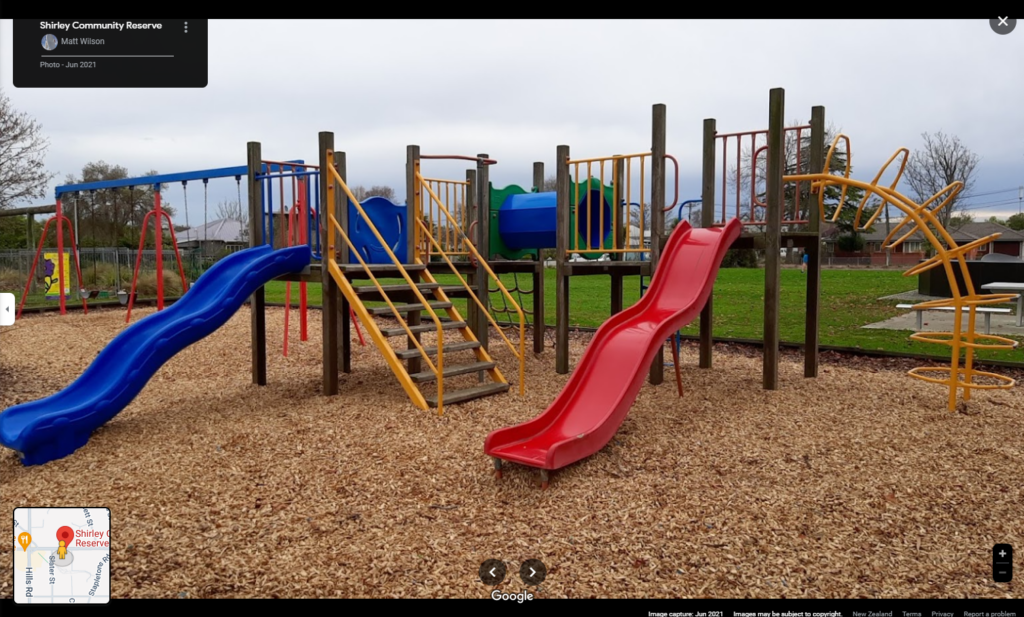
Current ‘Modular Play’ Playground Equipment
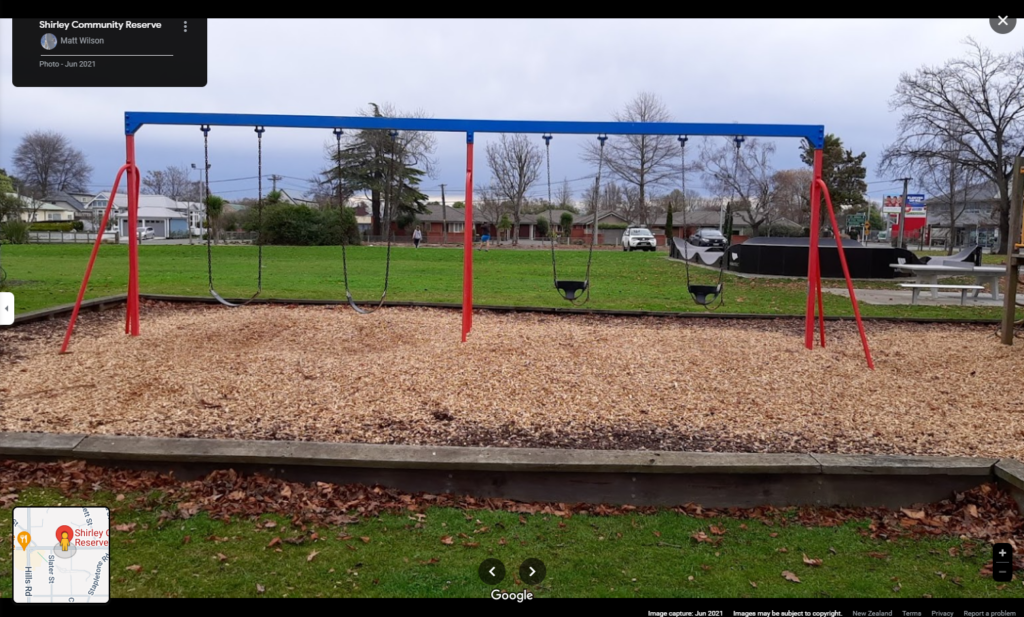
Current ‘Swing Set’ Playground Equipment
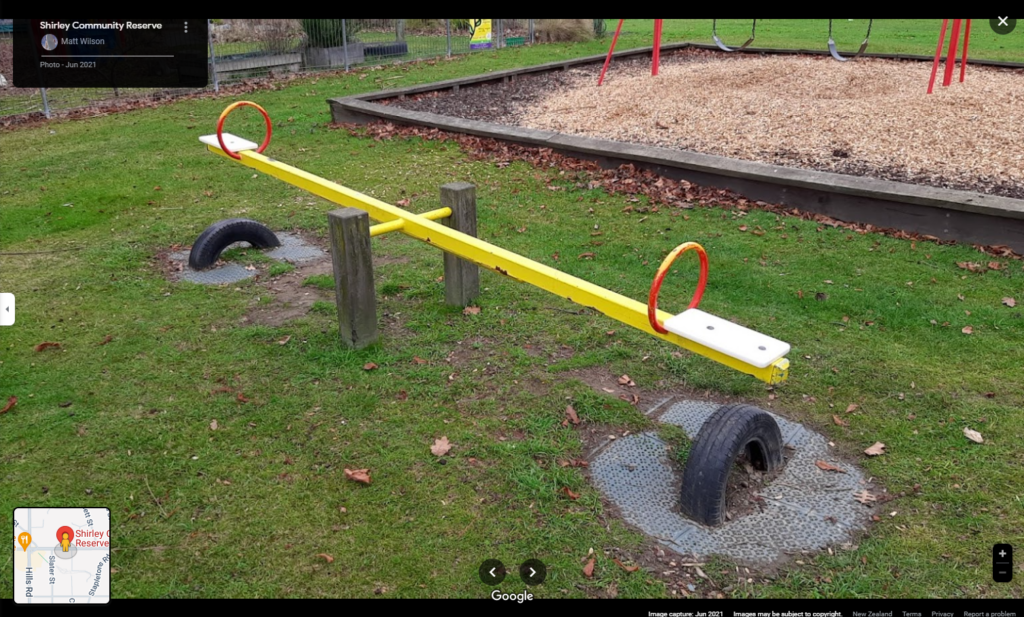
Current ‘See Saw’ Playground Equipment
2. Shirley Community Reserve | Playground Issues
– Playground is more suited for babies & preschoolers, requiring adult interaction.
– ‘Modular Play’ & ‘Swing Set’ are enclosed in a wooden frame (tripping hazard) with bark chips (accessibility issues for those with limited mobility & sensory issues).
– Lack of fenced area (near busy Shirley Road) & seating (for extending play time & observation location for children waiting to engage).
3. Shirley Community Reserve | Community Needs
– Child Development: More babies & preschoolers have limited opportunities to crawl (smaller houses = smaller lounge & hallway).
Crawling develops co-ordination & strong shoulder muscles, to help control their arm/hand for fine motor skills like writing. Create more opportunities for preschoolers/primary aged children to climb/crawl/hang.
– Inclusive Play Space: Designed to cater for the neurodiverse community (Feasibility Study 2023): “Opportunity to provide for inclusive play…Reserve is already currently fenced, which is rare particularly in the area north of Bealey Avenue…fenced playground…something the Disability community is advocating for more of, in particular the Autism community in Christchurch.”
3.1. CCC Equity and Inclusion Policy
https://www.10shirleyroad.org.nz/ccc-equity-and-inclusion-policy/
3.2. KOMPAN ‘The Universal Playground Design’
“A playground is only ever as good as the individual child’s experience of the play possibilities.
The playground can encourage or inhibit play through its location, design and equipment.
Children of all abilities report that the physical thrill and the social connectedness in play are the main attractions.
All children are different, and yet the vast majority of them are united in an inherent urge to play.
Some, however, cannot access play as easily due to disabilities or other challenges.”
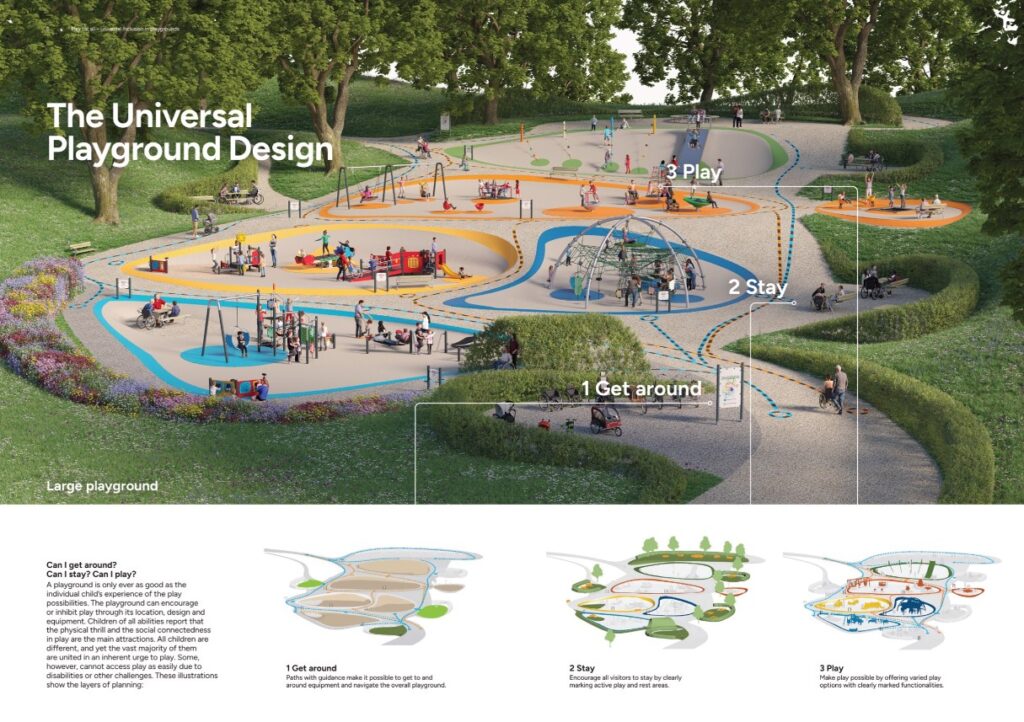
https://publications.kompan.com/aus/play-for-all/?page=6
‘The Universal Playground Design’:
– Can I get around?
1. Paths with guidance make it possible to get to and around equipment and navigate the overall playground.
– Can I stay?
2. Encourage all visitors to stay by clearly marking active play and rest areas.
– Can I play?
3. Make play possible by offering varied play options with clearly marked functionalities.
3.3. KOMPAN ‘Invisible Inclusion for All’
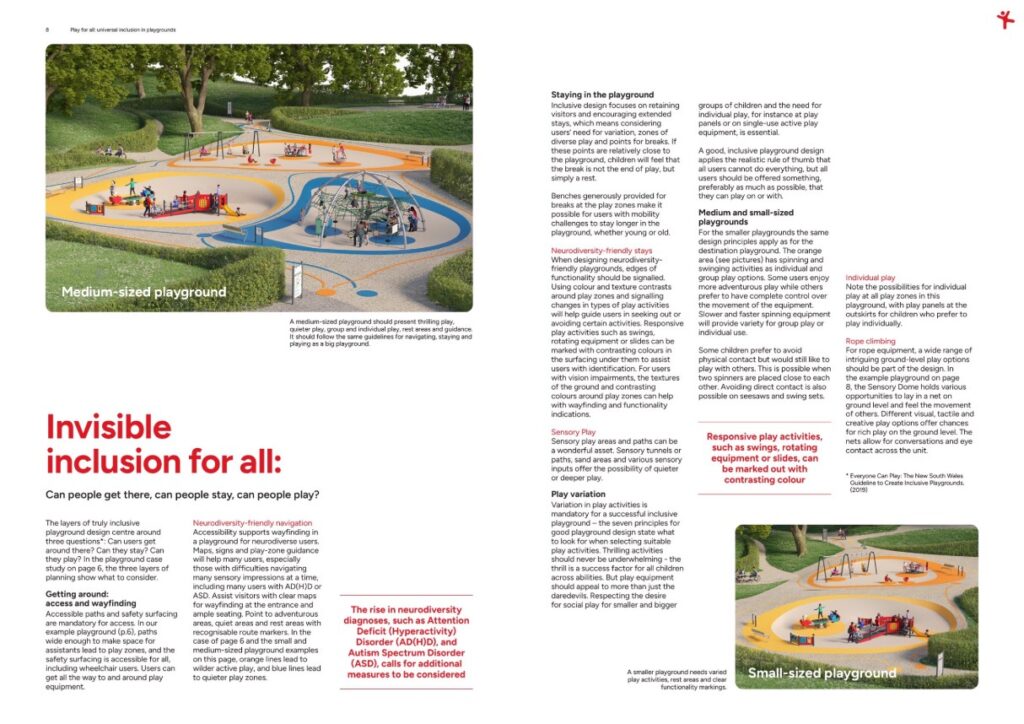
https://publications.kompan.com/aus/play-for-all/?page=8
– ‘Getting around: access and wayfinding‘:
Accessible paths and safety surfacing are mandatory for access. Paths wide enough to make space for assistants lead to play zones, and the safety surfacing is accessible for all, including wheelchair users.
– ‘Neurodiversity-friendly navigation‘:
Accessibility supports wayfinding in a playground for neurodiverse users.
Maps, signs and play-zone guidance will help many users with AS(H)D or ASD.
Assist visitors with clear maps for wayfinding at the entrance and ample seating.
Point to adventurous areas, quiet areas and rest areas with recognisable route markers.
– ‘Staying in the playground‘:
Inclusive design focuses on retaining visitors and encouraging extended stays, which means considering users’ need for variation, zones of diverse play and points for breaks. If these points are relatively close to the playground, children will feel that the break is not the end of play, but simply a rest.
Benches generously provided for breaks at the play zones make it possible for users with mobility challenges to stay longer in the playground, whether young or old.
– ‘Play variation‘:
A good, inclusive playground design applies the realistic rule of thumb that all users cannot do everything, but all users should be offered something, preferably as much as possible, that they can play on or with.
4. Shirley Community Reserve | CCC Draft Plan
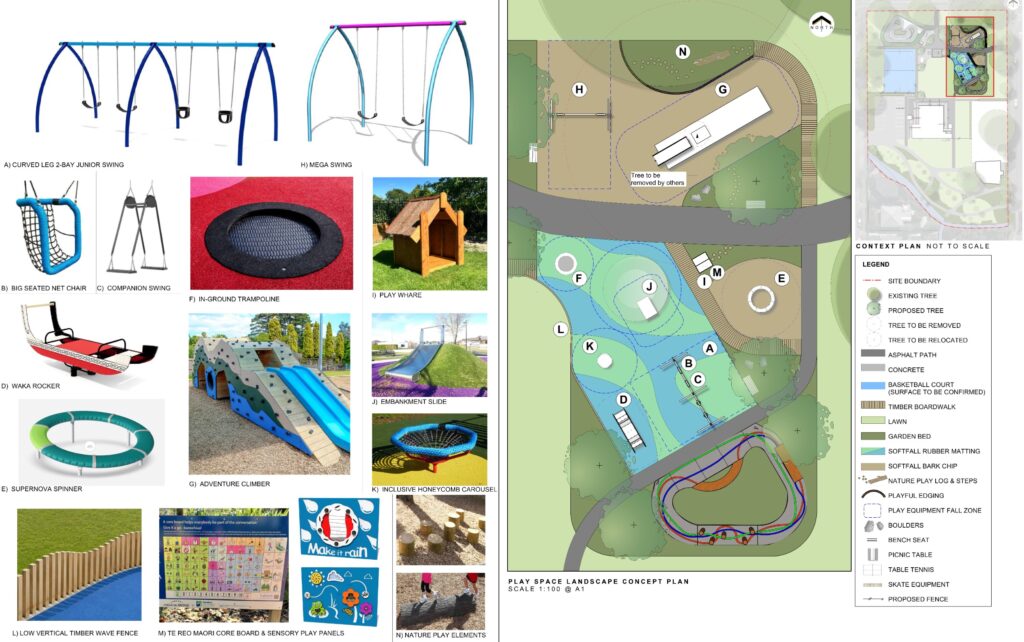
CCC Draft Plan | ‘Accessible Play’ & ‘Skills Loop’
https://letstalk.ccc.govt.nz/download_file/9954/3472 Page 3
4.1. CCC Draft Plan | Proposed Equipment
– Yes | A: Curved Leg 2-Bay Junior Swing
– Yes | B: Big Seated Net Chair
– Yes | C: Companion Swing
– Yes | D: Waka Rocker
– No | E: Supernova Spinner, design not suitable for preschoolers & those with physical issues.
– No | F: In-Ground Trampoline, rectangular shape to allow wheelchair users & more than one user at a time.
– No | I: Play Whare, better interactive whare design options available.
– No | J: Embankment Slide, design not suitable for those with physical issues & metal surface burns skin.
– Yes | K: Inclusive Honeycomb Carousel
– No | L: Low Vertical Timber Wave Fence, trip hazard for preschoolers & those with physical/mobility issues.
– Yes | M: Te Reo Māori Core Board & Sensory Play Panels
4.2. CCC Draft Plan | Proposed Design Feedback
– Equipment: Focus on Swings. No Climbing Equipment. Limited independent play options for preschoolers.
– Colour Scheme: Equipment needs to be ‘nature’ inspired, not bright, blues & greens, sensory friendly.
– Footpaths: Wider than normal, easy to navigate, simple direct access from A to B.
– Timber Boardwalks: Accessibility & safety issues due to slick surfaces for wheelchairs & strollers.
– Softfall Bark Chip: Can be challenging for some users with sensory sensitivities or mobility needs.
5. Shirley Community Reserve | ‘Shirley Centre’ Plan
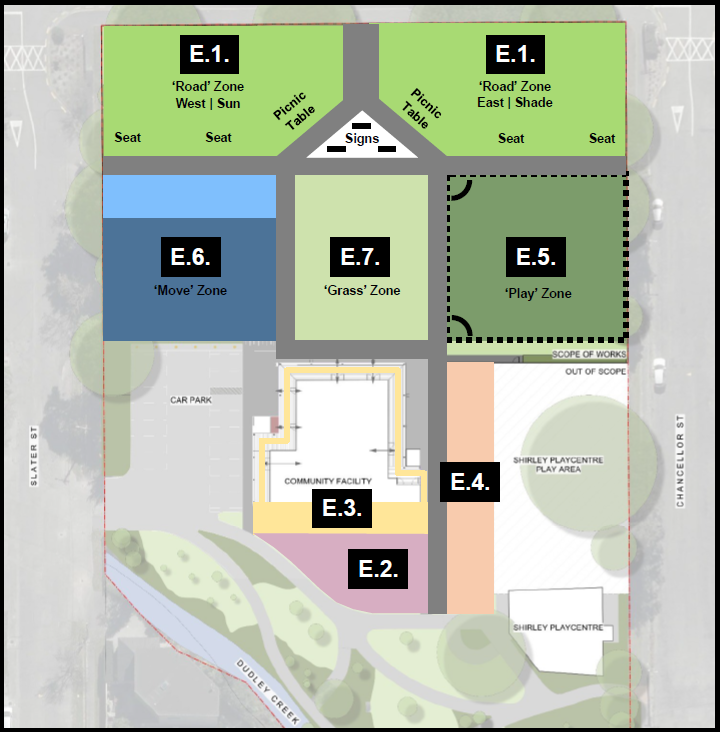
Consultation Feedback by Joanna Gould
E. ‘Shirley Centre’ Plan | E.5. ‘Play’ Zone
(Babies, Preschoolers, Primary Aged Children)
Fully Fenced, Inclusive, Accessible Play Space for Children
5.1. ‘Shirley Centre’ Plan | ‘Play’ Zone: Fencing, Trees & Seating
– Full fenced area with two access gates: North/close to Shirley Road & South/close to car park/playcentre.
– Trees (in appropriate locations) to provide shaded areas.
– Seating (in appropriate locations) for extending play time & observation location for children waiting to engage.
5.2. ‘Shirley Centre’ Plan | ‘Play’ Zone: Surface
One material: Softfall rubber surface & muted colours (green/grass, blue/water).
Children with sensory sensitivities may avoid textures like grass, bark chips, wooden boardwalks.
These textures can lead to meltdowns/shutdowns & avoidance of a play space.
Curves to provide movement through the ‘Play’ Zone, to depict our local waterways: Dudley Creek & the Ōtākaro Avon River.
Curves & lines can be used for wayfinding through a space, for children who like patterns.
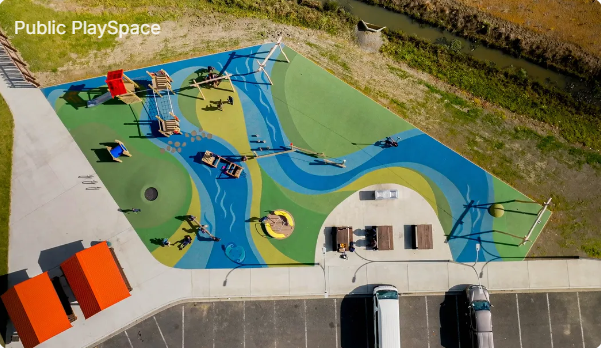
Whitikau Reserve Playground has become a symbol of community revitalization and cultural celebration.
“It’s about more than just play; it’s about our community’s identity.”
https://creospace.co.nz/portfolio/whitikau-reserve-playground-opotiki/
5.3. ‘Shirley Centre’ Plan | ‘Play’ Zone: ‘Tell Our Stories’
– ‘Cultural Elements: Breathing New Life into Playground Design’
https://creospace.co.nz/cultural-wildlife-playground-design/
“Why not weave culture and wildlife into your playground design? When you do, your playground stops being just a play area. It morphs into a vibrant centre for cultural and ecological learning.
Think of it as a fun and subtle way for kids to connect with their cultural roots and develop a sense of respect for wildlife…The playground becomes a place where play and learning go hand in hand. And in the process, they naturally develop a sense of community and environmental stewardship.”
– ‘Gateway to the East’ Vision
https://www.10shirleyroad.org.nz/ccc-draft-annual-plan-2026-2027/ Pages 14 & 15
Positioning 10 Shirley Road as a key entry point to the eastern suburbs and the Ōtākaro Avon River Corridor. Plans to integrate the facility with local history, green spaces, recreational areas, and transport routes. Emphasis on creating a welcoming and informative space for both residents and visitors to the East.
– ‘Gateway to the East’ Blog Post
https://www.10shirleyroad.org.nz/gateway-to-the-east/
‘3. Shirley Community Reserve | Location’ &
‘4. Ōtākaro Avon River Corridor | Activities’
– ‘Shirley Centre’ | Playground Ideas Blog Post
https://www.10shirleyroad.org.nz/playground-ideas/
Basket Swing: Fishing Nets/Sea,
Trampoline: New Brighton Pier,
Waka & Whare: Ngā Hau e Whā National Marae (Māori Heritage),
Boat: Lyttelton Port (British Heritage),
Brown Mounds: Port Hills,
Tunnel through Brown Mounds: Lyttelton Tunnel.
5.4. ‘Shirley Centre’ Plan | ‘Play’ Zone: Equipment Suggestions
– Modular Play: replace current equipment with ‘Mini Dome with Slide’ & ‘Play Whare’.
Opportunities for preschoolers/primary aged children to climb/crawl/hang/slide.
Designed for interactive games like peek-a-boo & tag etc.
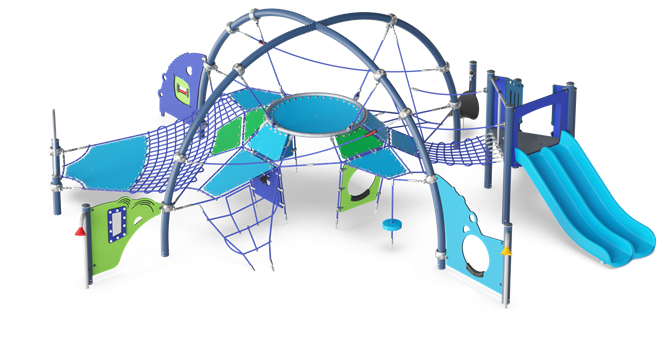
‘Play’ Zone Equipment Suggestions
Replace Current Playground = Mini Dome with Slide
https://www.playgrounds.co.nz/shop/product-detail/mini-dome-with-slide/
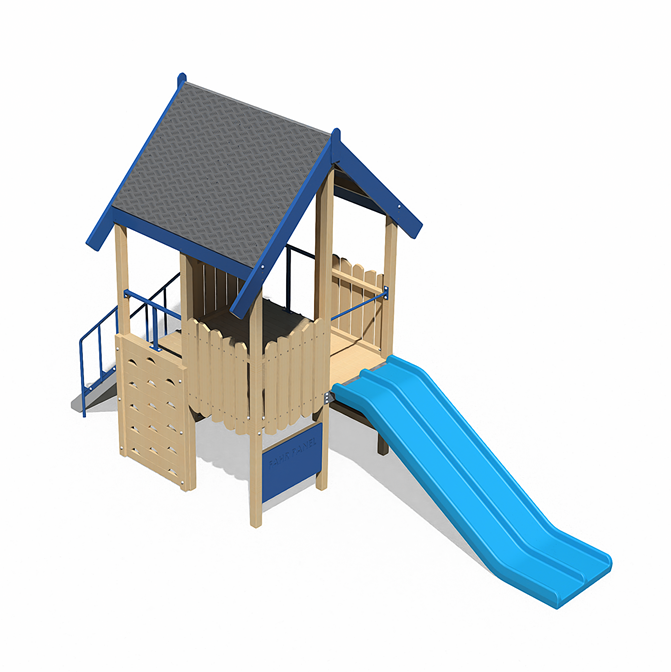
‘Play’ Zone Equipment Suggestions
Replace I: Play Whare = Platinum Play
https://www.playgrounds.co.nz/shop/product-detail/platinum-play-jt743-v3/
– Swing Set: replace current equipment with the CCC Draft Plan proposed swing set.
A. Curved Leg 2-Bay Junior Swing with (left to right):
1st position: B. Big Seated Net Chair
2nd position: Toddler Seat
3rd position: Standard Seat
4th position: C. Companion Swing
Keeping the B. & C. swings (that involve more than one person), easily accessible from the outer edge of the frame.
– See Saw: replace current equipment with the CCC Draft Plan proposed see saw = D. Waka Rocker.
– Spinners: replace the CCC Draft Plan proposed E. Supernova Spinner = Wheelchair Carousel. One level, inclusive & provides users with the option to sit or stand.
Include the CCC Draft Plan proposed K. Inclusive Honeycomb Carousel, for those users who enjoy spinning, but require more support.
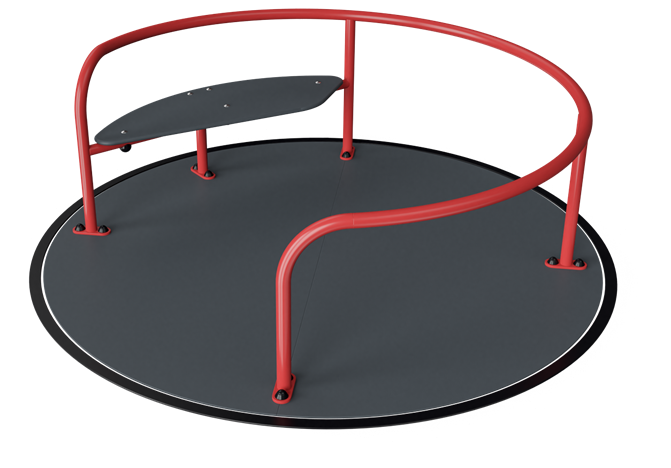
‘Play’ Zone Equipment Suggestions
Replace E. Supernova Spinner = Wheelchair Carousel
https://www.playgrounds.co.nz/shop/product-detail/wheelchair-carousel/
– Trampoline: replace the CCC Draft Plan proposed F. In-Ground Trampoline = Inclusive Rectangular Trampoline. Larger size, inclusive & more than one user at a time.
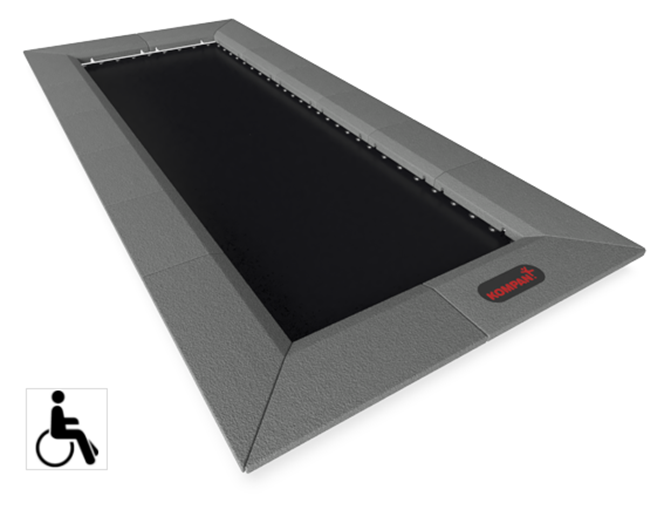
‘Play’ Zone Equipment Suggestions
Replace F: In-Ground Trampoline = Inclusive Rectangular Trampoline
https://www.playgrounds.co.nz/shop/product-detail/trampoline-rectangular-
100×300-cm—inclusive/
– Core Boards & Sensory Play Panels:
Include the CCC Draft Plan proposed M. Te Reo Māori Core Board & Sensory Play Panels.
Bilingual Core Boards featuring both Te Reo Māori and English, encourage Reserve users to learn & use both languages.
The Core Board will be beneficial for our neurodiverse & non-English speaking Reserve users.
Core Boards introduce literacy into the play area for younger Reserve users, connecting images & symbols to words.
Integrate the Core Board near the play structures not on a fence, so Reserve users don’t have to stop playing to communicate with others.
Sensory Play Panels engage Reserve users with activities designed to stimulate touch, sight, and sound.
These panels can be located at the outskirts of the play space, for children who prefer to play individually.